

10242 Greenhouse Rd #1002 Cypress, TX 77433
What Your Brain Map Reveals About Depression That a Standard MRI Misses

Depression doesn’t always look the way people expect it to. There’s no broken bone to show on a scan, no obvious structural damage that a radiologist can circle and hand back to you with a clear answer. And yet, something is happening inside the brain — something measurable, something real — that standard imaging often fails to capture. That gap between what you’re feeling and what conventional tests can show is one of the most frustrating parts of living with depression that doesn’t respond to treatment.
That’s exactly where qEEG brain mapping changes the picture.
What a Standard MRI Can and Cannot Show
An MRI is a powerful tool for looking at brain structure. It produces detailed images of the brain’s anatomy, identifying tumors, lesions, white matter changes, signs of stroke, and physical abnormalities that affect neurological function. For ruling out structural causes of symptoms, it’s genuinely valuable.
But depression, in most cases, is not a structural problem. It’s a functional one. The brain’s architecture may appear completely normal on an MRI, while its electrical communication patterns are significantly disrupted. Reduced connectivity between key regions, abnormal brainwave frequencies, and imbalanced activity between the left and right hemispheres don’t show up on a standard MRI because an MRI simply isn’t designed to measure those things.
Magnetic Depression Treatment Cypress works on a fundamentally different premise: that treating depression effectively requires understanding how your brain is actually functioning, not just what it looks like.
Research consistently supports this distinction. A peer-reviewed analysis published in Translational Psychiatry found that fMRI and standard MRI remain impractical as widespread clinical tools for predicting treatment response in psychiatry — in part due to high costs and limited access, but also because considerable analytical variability means different teams can reach different conclusions from the same dataset. EEG-based measures, by contrast, are more scalable and more consistent as clinical tools for guiding treatment decisions.
What qEEG Measures
A quantitative electroencephalogram — qEEG for short — is a non-invasive test that records the brain’s electrical activity in real time. A soft cap fitted with sensors is placed on your head to measure the electrical signals produced by your neurons. The result is a detailed map of your brain’s brainwave activity across multiple frequency bands: alpha, beta, theta, delta, and gamma waves.
What makes qEEG distinct from a standard EEG is the depth of analysis. A standard EEG records electrical activity and displays it as waveforms. A qEEG applies mathematical and statistical analysis to those waveforms and then compares your results against age- and gender-matched databases of individuals with no known neurological irregularities. The comparison is what turns raw data into meaningful clinical insight — showing not just what your brain is doing, but how it differs from a healthy baseline.
Here’s what that map can reveal in people with depression:
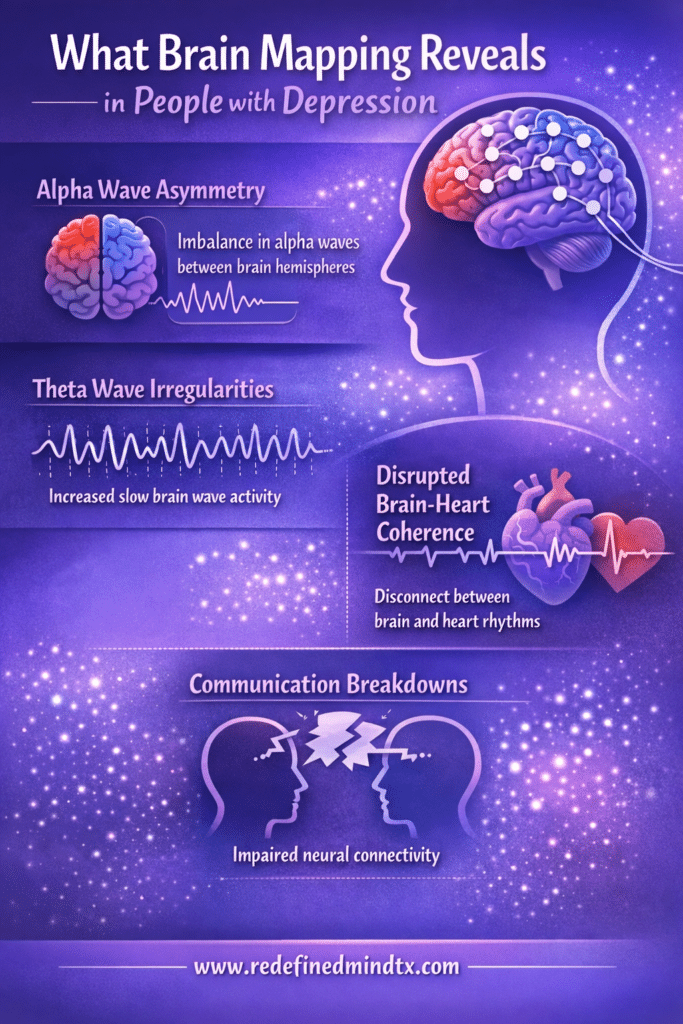
- Alpha wave asymmetry — Research published in PMC shows that asymmetry of alpha waves in the prefrontal regions, with dominant activity on the right side, is one of the most consistently observed patterns in major depressive disorder and is linked to the severity of depressive symptoms
- Theta wave irregularities — Elevated theta activity in the frontal regions is associated with cognitive slowing, low motivation, and the kind of mental fog that many people with depression describe
- Disrupted brain-heart coherence — Redefined Mind’s protocol includes an EKG alongside the qEEG to assess the communication relationship between the brain and the heart, a dimension that structural imaging doesn’t touch
- Communication breakdowns between regions — Reduced connectivity in frontoparietal control systems appears consistently in depression research, and qEEG analysis can reflect these network-level disruptions in a way that static structural imaging cannot
None of these patterns shows up on a standard MRI. All of them are clinically relevant to how depression presents and, critically, how it responds to treatment.
Why This Matters for Treatment
The reason qEEG data is so valuable isn’t just diagnostic — it’s directional. Knowing where your brain’s electrical activity deviates from a healthy pattern tells a clinician something far more specific than a symptom checklist alone: where to focus treatment.
This is the foundation of MeRT (Magnetic e-Resonance Therapy), which Redefined Mind offers at its Cypress-area practice. MeRT combines qEEG brain mapping with TMS (Transcranial Magnetic Stimulation), an FDA-cleared therapy for Major Depressive Disorder. Rather than applying stimulation to the same region at the same frequency for every patient as standard TMS protocols do, MeRT uses your qEEG results to calibrate both the location and frequency of magnetic stimulation to match your brain’s unique activity patterns.
The result is a treatment that isn’t guessing. It’s responding to what your brain map actually shows.
The Role of Ongoing Monitoring
One of the more meaningful aspects of this approach is that the qEEG isn’t just a one-time intake tool. At Redefined Mind, repeat brain maps are taken approximately every two weeks throughout the treatment course. This allows the clinical team to track how your brainwave patterns shift in response to treatment, adjust the protocol as needed, and connect measurable changes in brain activity to the improvements you’re reporting in mood, sleep, focus, and daily functioning.
That kind of ongoing, data-driven monitoring is a significant departure from how depression is typically managed — where adjustments to medication or therapy often happen based on subjective self-reporting alone, weeks or months after a change is made.
Who Benefits Most From This Approach
Not everyone with depression needs a brain map. But for a growing group of patients, it may be the missing piece.
You might be a strong candidate for qEEG-guided treatment if:
- You’ve tried antidepressants and haven’t found adequate relief, or have struggled with side effects that made continued use difficult
- Your depression has been present for years without a clear explanation or consistent response to treatment
- You’ve been told your symptoms are treatment-resistant
- You want to understand the biological picture behind what you’re experiencing rather than cycling through medications
Depression affects more than 300 million people worldwide, according to published research in PMC, and a significant portion of those individuals do not achieve full remission with standard treatments. For people in the greater Houston area, including Cypress, Katy, and The Woodlands, seeking a non-drug, non-invasive approach backed by measurable brain data, MeRT at Redefined Mind offers a concrete alternative.
If you’ve been managing depression without the results you were hoping for, a qEEG brain map may offer a different starting point. Contact Redefined Mind to schedule your initial assessment and find out what your brain’s activity patterns reveal.
People Also Ask
1. Is a qEEG brain map painful or uncomfortable?
No. The process is completely non-invasive and painless. A soft cap with sensors is placed on your head to record electrical activity. There’s no radiation, no needles, and no sedation required. Most people find the process straightforward and calm. The entire testing appointment at Redefined Mind, which includes both the qEEG and EKG, takes approximately 45 minutes.
2. How is MeRT different from standard TMS therapy?
Standard TMS applies magnetic stimulation to a fixed brain region at a standardized frequency for all patients. MeRT uses your qEEG results to individualize both the location and frequency of that stimulation to match your brain’s unique patterns. This means treatment parameters are tailored specifically to your brain map rather than being applied the same way for everyone. The underlying stimulation technology — TMS — is the same; what differs is how it’s guided and calibrated.
3. How long does a full course of MeRT treatment typically take?
Most treatment courses at Redefined Mind run between four and eight weeks, with daily sessions Monday through Friday. After the first two weeks, a follow-up qEEG is taken to assess how the brain is responding. Treatment is then adjusted based on those results and continued in two-week intervals with repeat brain mapping throughout. The total duration varies based on each individual’s response and the complexity of their presentation.
4. Can qEEG detect depression subtypes that respond differently to treatment?
Research in this area is actively developing. A 2024 Stanford Medicine study published in Nature Medicine identified six distinct biological subtypes of depression using brain imaging and machine learning — findings that underscore the clinical significance of understanding individual brain function rather than treating all depression as a single condition. qEEG-guided approaches like MeRT are built on this same premise: that the brain’s activity pattern matters for selecting the right treatment.
5. Does insurance cover qEEG brain mapping or MeRT treatment?
Coverage varies by plan. Some insurance providers may reimburse certain aspects of evaluation or treatment, but MeRT is currently considered out-of-network by many carriers. It’s worth contacting your insurance provider directly to understand your specific coverage. Redefined Mind’s team can also walk you through what to expect during your consultation.


We're here to listen, answer your questions, and provide the support you need.
Give us a call or Contact us through the form to discover how we can tailor our expertise to your unique needs.